House of the Dragon Season 3 Finale Recap: A Huge Battle Couldn't Save a Season That Wasted Too Much Time
- Young Horn

- Aug 9
- 11 min read
Well, Season 3 of House of the Dragon is officially over, and I really don't know how else to say it: I didn't think this finale, or honestly the season as a whole, was that good.
That's frustrating because I thought Season 3 started extremely well. The Battle of the Gullet immediately made it feel like the show had finally taken the training wheels off. The war was here, people were dying, dragons were involved, and it finally seemed like we were going to get the Dance of the Dragons we've spent two seasons waiting for. Instead, after that strong start, the show somehow found another way to crawl through huge portions of the season. We got great individual moments, some strong character work and a handful of legitimately excellent episodes, but the overall pacing never matched the urgency of the story they're supposed to be telling.
Then the finale arrives and suddenly we're getting one of the biggest battles in the history of the show.
Where was this urgency for the previous five weeks?
That doesn't mean there weren't things I loved about Episode 8. The Battle of Tumbleton looked incredible, Ormund Hightower remained one of the best additions to the entire series, and the episode finally pushed Rhaenyra into a much darker place. But one giant spectacle at the end doesn't automatically erase the feeling that the season spent too much time moving pieces around the board instead of actually letting them collide.
And unfortunately, when they finally did collide, some of the choices left me scratching my head.
The finale begins with Rhaenyra's entire world beginning to collapse around her. The news that Aegon II is alive hits her like a truck. She had publicly declared him dead, built part of her legitimacy around that information, and suddenly the man whose throne she believes she's taken is still breathing—and so is Sunfyre. Instead of responding calmly, Rhaenyra begins spiraling further into the version of herself we've watched slowly emerge throughout the season. She isn't simply trying to win a civil war anymore. She's beginning to convince herself that she has been chosen by something greater than politics.
That leads to one of the strangest scenes in the episode when Rhaenyra decides she needs the High Septon to publicly anoint her as queen. There's obviously political value in receiving the blessing of the Faith, but she has already been rejected, Aegon has already been formally crowned, and somehow Rhaenyra thinks marching into the Sept with armed guards is going to solve the problem. When the High Septon refuses again, she has Alyn and her men kill him and those around him before stepping outside to address the people.
And this is where the prophecy stuff completely lost me.
Rhaenyra stands before the crowd in armor and begins publicly talking about Aegon's dream, the Song of Ice and Fire and the great darkness that's eventually coming from the North before declaring herself the Prince That Was Promised. Even some of her own supporters look at each other like, "What the hell is she talking about?" The entire scene is supposed to show how completely Rhaenyra has embraced this belief that her claim to the throne isn't merely political—it is destiny.
I understand what the writers are trying to do.
I just don't love it.
The Dance of the Dragons doesn't need some enormous supernatural justification. This story was already fascinating because it's about a family destroying itself over succession, pride, resentment and power. Rhaenyra believes the throne belongs to her because her father named her heir. The Greens believe a first-born son should inherit. Otto wants his bloodline on the throne. Daemon wants power. Aegon wants revenge. Those motivations are already enough.
We don't need to make everyone secretly responsible for stopping the White Walkers.
Sometimes people destroy entire kingdoms simply because they want power.
That is much more interesting to me.
Rhaenyra's transformation continues through her treatment of Helaena. Helaena has stopped eating, and when Rhaenyra tries reasoning with her, Helaena tells her exactly what she thinks: King's Landing is ugly, everything around them is ugly, and Rhaenyra herself has become ugly. Not physically. Morally. Rhaenyra responds by ordering her guards to force-feed Helaena while she screams and fights them off.
That might be the clearest moment yet showing how far Rhaenyra has fallen.
Earlier seasons constantly asked us to compare Rhaenyra and Alicent as mothers, women and political figures trapped inside the same patriarchal system. By this point, Rhaenyra isn't thinking about any of that anymore. People have become pieces on her board. You're either useful to her claim or you're standing in the way of it.
Baela basically calls her out for exactly that. Rhaenyra has started treating everyone around her as tools rather than family or allies, and when Baela pushes back, Rhaenyra responds by confining her and her dragon to the Red Keep. Even Mysaria, who has arguably done more than almost anyone to help Rhaenyra reach this point, is dismissed and sent away.
And immediately, that comes back to bite her.
Because maybe, and I'm just throwing this out there, letting your spymaster walk out the front door after you've pissed her off isn't a great idea.
Mysaria almost instantly starts working against her, informing Helaena that Aegon is alive and warning her that her unborn child will essentially become Rhaenyra's hostage. It is one more example of Rhaenyra believing power automatically equals control when really she's losing control of almost everyone around her.
Then we finally get to the part of the episode everyone was waiting for.
Tumbleton.
Daemon and the Black forces arrive with the Riverlanders, Northmen and Winter Wolves prepared to take the city from Ormund Hightower. The problem is that Ormund has anticipated exactly how Rhaenyra wants the battle fought. He knows Team Black doesn't want images of dragons burning innocent civilians destroying whatever legitimacy Rhaenyra still has, so he literally lines the walls with children as human shields.
That's how ruthless this guy has become.
I have to give the show credit for Ormund Hightower. James Norton has been excellent all season, and turning Ormund into one of the major masterminds of Team Green was one of the better changes from Fire & Blood. He's smart, manipulative and completely willing to do whatever it takes to survive. Even when his own side is falling apart around him, he's thinking three moves ahead.
Before the battle begins, Gwayne Hightower brings Lord Corlys to negotiate with Daemon. Their proposal is basically an attempt to split Westeros: allow Rhaenyra to rule part of the realm while Daeron controls the Reach and the territories loyal to the Greens. Corlys even tries modifying the deal by suggesting Daeron be named Warden rather than king. Daemon wants absolutely nothing to do with it. He takes Corlys back into custody, tells Gwayne where he can stick the proposal, and sends him back to Tumbleton.
And finally...
We get war.
Actual war.
Roddy the Ruin and the Northmen charge the walls through a hail of arrows. Soldiers are climbing ladders while boiling oil rains down. Battering rams smash against the gates. Men are fighting in the streets. For once, House of the Dragon pulls the camera back and reminds us that this is supposed to be one of the largest civil wars Westeros has ever experienced.
Visually, the Battle of Tumbleton is fantastic.
This is what I've wanted from the show.
Caraxes eventually gets involved after the battering ram fails, and Daemon uses him to break through the gates. Even then, the children placed in front of the entrance create another moral problem. Most eventually move after Daemon urges them away, but Ormund's strategy works long enough to make Team Black hesitate.
Meanwhile, Ulf the White is apparently preparing for the biggest battle of his life by passing out in a latrine.
Of course he is.
Ormund eventually tracks him down, insults him, kicks him around and demands he get on Silverwing and do the job he was promised to do. The problem is Ormund has spent the entire season treating Ulf like garbage while simultaneously expecting him to remember his place.
Ulf has a dragon.
His "place" can change pretty quickly.
When Silverwing finally takes flight, Ulf initially turns her fire on Daemon's troops, fulfilling the betrayal Ormund had been planning. But then Ulf basically decides he's sick of everybody. Instead of simply helping Team Green, he turns Silverwing toward Tumbleton itself and begins torching the city.
Complete chaos.
Exactly what this war should feel like.
Roddy the Ruin, meanwhile, gets maybe the most badass death of the entire season. Even after losing an arm, he manages to reach Ormund and land the killing blow. Then Silverwing appears above them, fire incoming, and Roddy basically laughs in the face of death while Ormund realizes everything he built has collapsed around him.
That's how a warrior dies.
Criston Cole could never.
But then we get to Daemon.
Daemon spends the battle fighting through Tumbleton on foot and eventually runs into Ser Jon Roxton, who is bigger, heavily armored and clearly getting the better of him. For a minute, I genuinely thought we were watching Daemon Targaryen die.
And I'll just say it.
I don't think HBO wanted to kill him.
I know what happens in Fire & Blood. I understand they are rearranging events and condensing storylines for television. But watching the way this scene plays out, it absolutely felt to me like the writers wanted the audience to believe Daemon was finished without actually having the guts to lose Matt Smith yet.
Roxton has him.
Daemon is basically cooked.
And then a building conveniently collapses between them after being hit by dragonfire, saving Daemon at exactly the right moment. He crawls away, gets back to his feet and eventually Corlys finds him and gets him out of the burning city.
Come on.
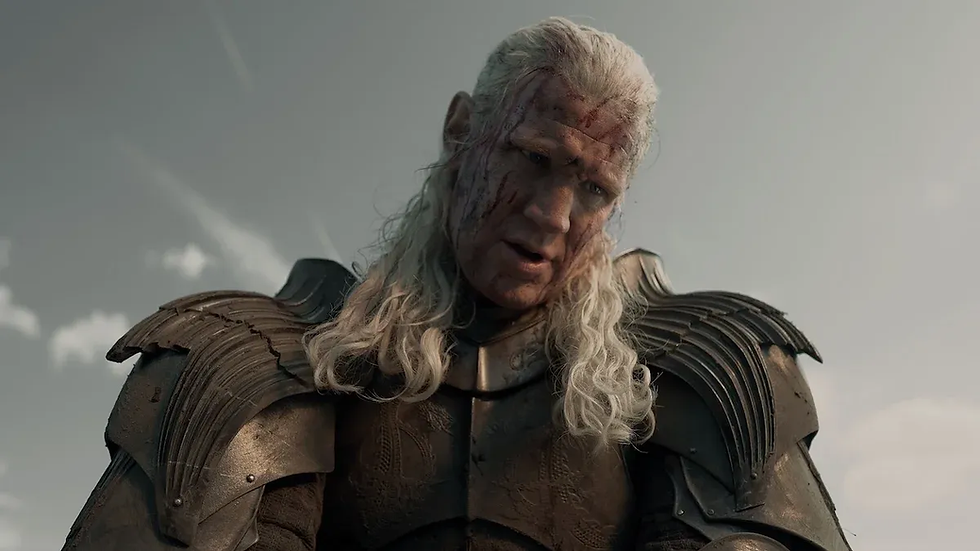
Maybe I'm being cynical, but Matt Smith's Daemon is easily one of the most popular characters on this show, and it feels like HBO knows it. Daemon has basically been the face of House of the Dragon alongside Rhaenyra since Season 1. I don't believe they were ready to go into the final season without him, so instead we get a fake-out death where the ceiling falls at the exact second necessary to save his life.
Again, that's my interpretation.
But it felt very television.
And considering how much of Daemon's Season 3 storyline involved him disappearing, lying, wandering around Harrenhal and eventually returning to the war, I think keeping him alive purely because he's a fan favorite would be a mistake if that's actually what drove the decision. Characters in Game of Thrones became legendary precisely because popularity didn't protect them.
Ned Stark was popular.
Robb Stark was popular.
Oberyn Martell was popular.
Didn't matter.
Westeros doesn't care.
That's part of what made the original series terrifying.
If Daemon survives because the story demands it, fine.
If Daemon survives because HBO doesn't want to lose Matt Smith yet, that's different.
The aftermath of Tumbleton is devastating. Hugh finds his wife dead among the destruction, which immediately creates another potential fracture within Team Black. Ser Roxton finds Ormund's body. Gwayne searches through the rubble for Daeron, whose fate remains intentionally unclear heading into Season 4. Above the destruction, dragons circle while the surviving Black forces retreat from what has basically become a burning graveyard.
Then the episode returns to King's Landing for its most tragic moment.
Helaena kills herself.
After everything she's endured—the death of her child, imprisonment, her visions, Rhaenyra's increasingly cruel treatment and Mysaria telling her that Aegon lives while her unborn child will remain a political hostage—Helaena walks to the window and jumps. She is impaled below, ending the life of arguably the most innocent person left in this entire war.
It's supposed to be devastating.
And it is.
But I don't think the show earned it as well as it could have.
Part of the problem is removing Maelor from the story. In Fire & Blood, there are several accounts of what drives Helaena toward her death, and the loss of her child plays an enormous role in those versions. The show has changed so much of that storyline that her suicide feels more abrupt than tragic inevitability. Even Forbes' Erik Kain, who otherwise gave the finale a glowing review, questioned whether this version of Helaena's death works given that her daughter remains alive and trapped inside the Red Keep.
The final image involving Helaena is still powerful.
Rhaenyra discovers the tapestry Helaena had been creating, depicting her own fall and Rhaenyra sitting upon the Iron Throne surrounded by fire and blood. Helaena knew. She always knew. And instead of seeing her death finally break Rhaenyra, we get almost nothing from the queen. She looks at the tapestry and continues down the path she's chosen.
That's really the story of the finale.
Rhaenyra finally gets closer to becoming the person everyone accused her of becoming before she actually was.
The compassionate version of Rhaenyra we've watched fight against this transformation for three seasons is disappearing. She is executing religious leaders, imprisoning family members, force-feeding Helaena, pushing away advisers and publicly declaring herself part of a divine prophecy.
She wants the throne.
And she's reached the point where almost anything can be justified if it gets her there.
My Problem With Season 3
This is where I struggle with the season as a whole.
Season 3 started like it was going to be incredible.
The Battle of the Gullet immediately raised the stakes. We had war, consequences and major changes to the board. Ormund Hightower was a fantastic addition. Aegon's storyline was consistently entertaining. Sunfyre's return was one of my favorite moments of the season. Helaena's visions became increasingly important. Criston Cole finally got the death he deserved.
There were good pieces everywhere.
But connecting those pieces took forever.
There were too many episodes where characters talked about what they were eventually going to do rather than actually doing it. Too much Harrenhal hallucination material. Too many councils repeating the same arguments. Too much prophecy. Too many storylines that felt like they were waiting for the finale to give them permission to move.
And then Episode 8 suddenly throws the Battle of Tumbleton, Ormund's death, Ulf's betrayal, Helaena's death, Rhaenyra's religious transformation, Daeron's uncertain fate and Daemon nearly dying into one episode.
Spread some of that urgency around!
That's what makes this season frustrating rather than outright bad.
The ingredients were there.
The execution wasn't consistent.
MVP
Roddy the Ruin
Lost an arm, killed Ormund Hightower anyway and then laughed while dragonfire came down on top of him.
That's about as Westerosi as it gets.
Honorable mention to James Norton's Ormund, who was legitimately one of my favorite characters introduced this season.
L of the Episode
Rhaenyra Targaryen
You can argue she's becoming more powerful, but she's losing practically everything else. Her advisers don't trust her. Her family is turning against her. Mysaria is now working behind her back. Helaena despises her. And she's standing in front of confused peasants declaring herself the Prince That Was Promised.
Things are going great.
Final Season 3 Dragon Power Rankings
1. Vhagar – Still the measuring stick. Until somebody kills Aemond's flying nuclear weapon, every other dragon is competing for second place.
2. Caraxes – Survives Tumbleton and remains Daemon's greatest weapon. Still built like the longest dragon ever created.
3. Sunfyre – Coming back from what everyone thought was death automatically earns a spot near the top.
4. Silverwing – Ulf basically turned Tumbleton into hell on earth. Huge finale for Silverwing.
5. Vermithor – Hugh's storyline feels like it's headed somewhere extremely dark after what happened to his wife.
Heading Into the Final Season
Season 4 now has an enormous amount to resolve. Daemon and Aemond are obviously moving toward whatever their final confrontation becomes. Hugh has every reason to become increasingly unpredictable after losing his wife. Ulf has proven that giving a drunken lunatic one of the largest dragons in Westeros may not have been the smartest decision anyone has ever made. Aegon is alive. Sunfyre is alive. Daeron's fate remains unresolved. Rhaenyra is becoming increasingly tyrannical, and King's Landing is basically waiting to explode.
There's still plenty of great material left.
That's why I'm not giving up on the show.
But with Season 4 confirmed as the final season, there are no more excuses.
You can't spend another season moving pieces around.
It's time to finish the Dance.
Season 3 had moments where House of the Dragon looked every bit like the worthy successor to Game of Thrones that HBO promised us.
Unfortunately, it also had too many moments where it felt terrified to actually get where it was going.
The finale gave us fire.
I just wish the rest of the season hadn't spent so much time looking for the match.



Comments