Same Front Office. Same Manager. Same October Failure. At Least the Yankees Finally Admitted the Players Weren't Good Enough.

Hal Steinbrenner, Brian Cashman and Aaron Boone faced the media Wednesday following another disappointing Yankees postseason. There was accountability, some refreshing honesty and plenty of familiar explanations. But with the franchise entering its 18th season without a World Series championship, how much longer can New York keep running it back?
Another October has come and gone, and once again, the New York Yankees are sitting at home watching somebody else compete for a World Series championship.
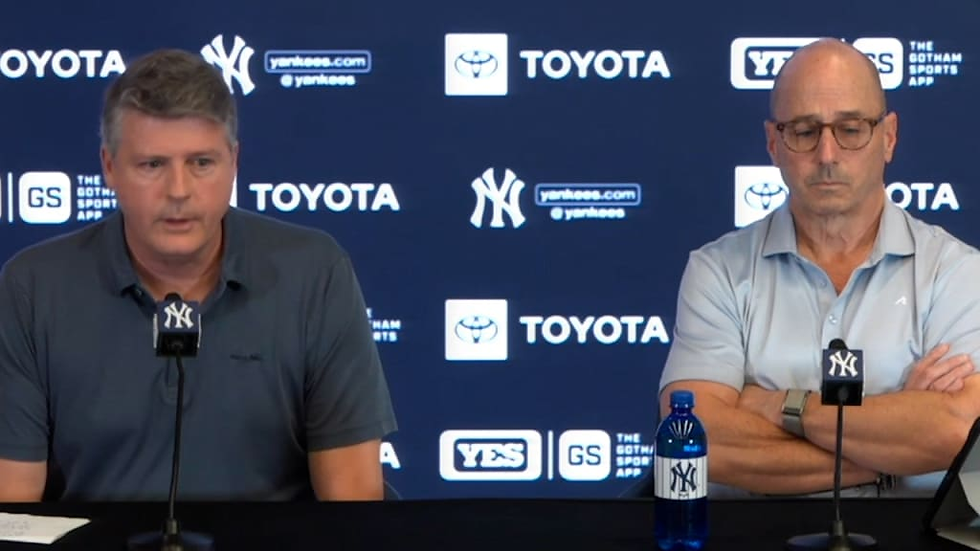
Seventeen consecutive seasons without a title. Seventeen years of expectations, massive payrolls, promising regular seasons and playoff exits that somehow manage to feel increasingly familiar. And Wednesday morning, Hal Steinbrenner, Brian Cashman and Aaron Boone stepped in front of the media to explain why another season ended without the Yankees accomplishing the one thing this organization is supposed to measure itself against.
Winning a World Series.
And after listening to what all three had to say, I walked away with two completely different reactions.
First, I actually appreciated some of the honesty.
For once, there wasn't an attempt to completely disguise what happened by talking about how difficult baseball is, how unpredictable the postseason can be or how the Yankees were only a few breaks away from advancing. Steinbrenner made it clear that he wasn't satisfied with the results, acknowledged the offensive inconsistencies that plagued this team and, most importantly, put a significant portion of the responsibility directly on the players.
Good.
Because somebody needed to say it.
But my second reaction was the same frustration I've felt for years.
If everybody understands what went wrong, why does it feel like we're heading into another season with essentially the same people making the same decisions and expecting a different result?
Because that's exactly what's happening.
Brian Cashman is coming back. Aaron Boone is coming back. Hal Steinbrenner remains convinced that the people running his baseball operation are capable of delivering a championship.
And Yankees fans are being asked to believe in the process for another year.
Sound familiar?
At Least Hal Steinbrenner Finally Put Some Responsibility on the Players
Of everything discussed Wednesday, I thought Steinbrenner's comments about the players were probably the most refreshing.
The Yankees finished the regular season with 93 wins. They overcame significant injuries, reached the postseason and eliminated the Boston Red Sox in the Wild Card round. Those accomplishments shouldn't be completely dismissed simply because the season ended badly.
But nobody in the Bronx is hanging a banner for winning 93 games.
And Steinbrenner seemed to understand that distinction.
He acknowledged that reaching the Division Series wasn't necessarily a failure in itself, but what happened once the Yankees got there absolutely was.
That's exactly how I look at it.
There's a difference between losing a competitive playoff series to a better team and looking completely unprepared to compete when the games matter most.
The Yankees didn't just lose to Tampa Bay.
They were swept.
Three games. Five total runs scored. An offense that practically disappeared and a defense
that committed the kind of mistakes you'd expect to see in spring training, not October.
This wasn't some heartbreaking seven-game series where the Yankees fought until the final inning and simply came up short.
They went out quietly.
And that should bother everybody associated with this organization.
Steinbrenner specifically pointed toward the offensive inconsistency that followed the
Yankees throughout the season. He also defended Boone's handling of a pitching staff that dealt with injuries and constant adjustments.
I don't necessarily disagree with either assessment.
The Yankees were capable of looking like one of the most dangerous offenses in baseball for a week, only to turn around and struggle to string together three competitive at-bats the following series.
We watched it happen in real time.
Against Boston, the lineup looked patient, aggressive in the right situations and capable of producing runs without depending entirely on home runs.
Then Tampa Bay showed up.
And apparently everybody forgot how to hit.
At some point, the players have to take responsibility for that.
Aaron Boone isn't the one standing in the batter's box chasing pitches outside the strike zone. Brian Cashman isn't the one leaving runners stranded. Hal Steinbrenner isn't the one committing errors behind a young pitcher trying to keep his team alive in a postseason series.
The players are.
And when you're making millions of dollars to perform at the highest level, criticism comes with the territory.
I don't care how much somebody makes, what their regular-season numbers looked like or how popular they are with the fan base.
If you disappear in October, you deserve to hear about it.
The Highest Payroll in Yankees History. And What Exactly Did It Buy?
This was another part of Wednesday's press conferences that I appreciated.
The Yankees didn't pretend they were operating on some shoestring budget.
They acknowledged that the organization entered the season with the highest payroll in franchise history and that the roster was constructed with championship expectations.
That's important.
Because I'm tired of hearing conversations about how much money the Yankees spend as if simply opening the checkbook should be considered an accomplishment.
Nobody is questioning whether the Yankees spend money.
They obviously do.
The question is whether they're spending it on the right players.
There's a massive difference.
If you're spending hundreds of millions of dollars and still watching the same offensive shortcomings show up every October, something is wrong with how the roster is
constructed.
And I don't think it's unfair to ask whether this front office has become too comfortable building teams that look great on paper but have glaring weaknesses when facing elite postseason pitching.
We've watched this happen repeatedly.
The Yankees hit home runs. They win regular-season games. They put up impressive offensive numbers against mediocre pitching.
Then October arrives, opposing teams shorten their rotations, pitchers attack weaknesses more aggressively and suddenly the lineup can't manufacture a run.
Of course, every team struggles against good pitching.
That's why those pitchers are good.
But the Yankees seem to make a habit of allowing one difficult matchup to turn into an entire series of offensive frustration.
And that's not something you can keep explaining away as bad luck.
The absence of Aaron Judge was obviously enormous this season. Losing your best player is going to hurt any organization, especially when that player is one of the best hitters in baseball.
But that's also why you build an expensive roster around him.
The Yankees weren't paying all that money just to have a competitive lineup when Judge was healthy.
They were supposed to have enough talent to survive without him.
And in October, outside of Ben Rice, the production simply wasn't there.
If we're going to acknowledge the players didn't perform, we also have to acknowledge that the front office is responsible for deciding which players are wearing those uniforms.
You don't get to separate those two things entirely.
Brian Cashman Gets Another Contract. Because Apparently 29 Years Isn't Enough Time to Evaluate Him.
Now we get to the part of Wednesday that really frustrated me.
Brian Cashman is returning.
Again.
The man has been running the Yankees' baseball operations since 1998. He's been part of
four World Series championships as general manager, and I will never pretend those accomplishments don't matter.
They absolutely do.
Cashman has also maintained a remarkable level of regular-season consistency. The Yankees haven't had a losing season under his leadership, and they've reached the postseason far more often than they've missed it.
Those are legitimate accomplishments.
But at what point do we stop evaluating the Yankees based on their ability to qualify for the postseason and start evaluating them based on their inability to finish the job?
Because the last championship came in 2009.
That's seventeen seasons without a title.
And while Cashman deserves credit for building competitive teams, he also deserves criticism for the fact that so many of those teams have fallen short in remarkably similar ways.
This isn't about pretending the Yankees are some terrible organization.
They're not.
There are plenty of fan bases that would love to experience the level of consistent winning the Yankees have enjoyed.
But this is the New York Yankees.
The standards are supposed to be different.
And when you've been given nearly three decades to run one of the wealthiest organizations in professional sports, I don't think it's unreasonable for fans to question whether somebody else might have a better approach.
Cashman talked about the importance of getting into the postseason and having enough talent to compete once you're there.
I understand the philosophy.
You can't win the World Series without making the playoffs.
But simply getting there shouldn't be the final argument for why the same general manager deserves another contract.
Not when the same organizational weaknesses keep showing up.
Not when the championship drought continues growing.
And certainly not when the team just spent more money than ever before and managed five runs in an entire Division Series.
I'm not saying Cashman has forgotten how to build a baseball team.
I'm saying maybe this organization needs a different perspective.
A different approach to constructing a lineup.
A different philosophy when it comes to balancing power, contact, defense and athleticism.
Something.
Because continuing to run the same formula back every year and hoping October suddenly produces a different result is getting exhausting.
Aaron Boone Is Returning, and I'm Not Sure What We're Supposed to Expect to Change
Then there's Aaron Boone.
Another season. Another postseason disappointment. Another offseason defending the manager.
Boone will return for his tenth season in 2027, and he'll do so entering the final year of his current contract.
Steinbrenner praised the job Boone did managing the pitching staff, especially with the injuries and changes the Yankees dealt with throughout the year.
And I'll give Boone credit for that.
Managing a rotation that's constantly changing isn't easy. Dealing with an exhausted bullpen isn't easy. Keeping a team competitive through significant injuries requires communication, adjustments and leadership.
Boone deserves recognition for those things.
But I also think it's fair to question whether he's the manager who can finally push this organization over the top.
Because the Yankees have developed a frustrating identity during his tenure.
There are stretches when they look unstoppable.
Then there are stretches when they look completely lifeless.
And too often, the postseason brings out the worst version of this team.
Now, Boone isn't responsible for every defensive error or every strikeout.
I'm not going to blame him for a professional baseball player failing to make a routine throw.
But managers are responsible for preparation, accountability, lineup construction and creating an environment where players consistently execute.
And when the same mistakes keep happening, those responsibilities become fair game for criticism.
Think back to Game 2 against Tampa Bay.
Cam Schlittler was handed the baseball with the Yankees already trailing the series 1-0.
What happened?
Three first-inning errors, including catcher's interference, and a young pitcher forced to battle through unnecessary trouble almost immediately.
The Yankees eventually committed four errors in that game.
That's embarrassing.
And while Boone didn't personally commit those errors, I don't think it's unreasonable to ask why a team with championship aspirations looked that sloppy in one of its biggest games of the season.
There has to be accountability beyond simply saying the players didn't execute.
Boone also acknowledged Wednesday that the Yankees' offense had been inconsistent throughout the year and that the lineup looked completely different against Tampa than it did against Boston.
Exactly.
So what is the organization doing to prevent that from happening again?
Because recognizing the problem is one thing.
Fixing it is another.
And after nine seasons, I think fans have every right to wonder whether Boone is capable of delivering that solution.
The Tampa Bay Series Was Everything Wrong With This Team in Three Games
What makes this entire situation so frustrating is that the Division Series against Tampa Bay was almost a perfect summary of the Yankees' recurring problems.
Game 1 was a pitching duel.
Gerrit Cole gave New York a performance that should have provided an opportunity to steal the opening game on the road.
The offense gave him nothing.
Game 2 was even worse.
Schlittler was forced to navigate one defensive mistake after another while the offense once again failed to produce anything meaningful outside of Ben Rice's two solo home runs.
And by Game 3, the Yankees were facing elimination after failing to win a single game in Tampa.
They couldn't recover.
Season over.
What bothers me most is that we had just watched the same group play excellent baseball against Boston.
They were working counts, making contact and getting contributions throughout the lineup.
For two games, it felt like the Yankees had finally figured out that winning postseason baseball doesn't always require somebody hitting a three-run homer.
Then the Rays series started and everything disappeared.
How does that happen?
How does an offense look so comfortable one week and completely helpless the next?
At some point, we have to stop pretending this is just an unfortunate coincidence.
The Yankees have built a reputation for struggling to adjust when an opponent finds a weakness.
And if the organization doesn't address that issue, we're going to be having this exact same conversation next October.
Hal Steinbrenner Is Right About the Players. But Accountability Has to Go Both Ways.
This is where I think Wednesday's press conferences became particularly interesting.
Steinbrenner made it clear that he didn't believe the disappointing finish should be pinned entirely on Boone or Cashman.
Instead, he pointed toward the players failing to deliver when it mattered.
And again, I agree with a significant portion of that argument.
The players absolutely deserve criticism.
But accountability cannot stop at the clubhouse door.
If the players are consistently underperforming in October, who is responsible for acquiring them?
Who determines the organizational hitting philosophy?
Who decides which players deserve starting roles?
Who makes the lineup decisions?
Who determines whether a struggling player should continue receiving opportunities?
Those questions matter.
And the answers eventually lead back to the people running the organization.
That's why I have a difficult time accepting that the players are responsible for the failures while the manager and general manager continue receiving the full confidence of
ownership.
It doesn't have to be one or the other.
Both can be true.
The players failed.
The coaching staff failed to get enough out of them.
And the front office assembled a roster that wasn't good enough to overcome its
weaknesses when the season mattered most.
That's organizational failure.
And if the Yankees are serious about changing the results, everybody should be evaluated accordingly.
Seventeen Years Without a Championship Should Make Everybody Uncomfortable
I think one of the biggest problems surrounding the Yankees right now is that the organization has become almost too comfortable with being competitive.
Winning 90 games is impressive.
Making the playoffs is impressive.
Remaining relevant every September is impressive.
But none of those accomplishments are what built the Yankees into the most successful franchise in baseball history.
Championships did.
That's the standard generations of Yankees fans grew up expecting.
And I understand that baseball has changed.
There are more playoff teams. More competitive organizations. More financial resources spread throughout the league. Winning a World Series is incredibly difficult, and nobody is entitled to a championship simply because they wear pinstripes.
But that doesn't mean the standard should disappear.
The Yankees have the money, resources, facilities and organizational history to compete for championships every year.
And when they fail, the response should be more than simply acknowledging how disappointing the season was.
There should be genuine urgency to change whatever isn't working.
That's what I want to see this offseason.
Not another collection of familiar explanations.
Not another argument about how successful the regular season was.
And not another winter where the biggest news is that everybody in charge is returning.
I want to see an organization willing to admit that being good enough to make the postseason and being built to win the World Series are two very different things.
Because right now, the Yankees seem to have mastered the first part.
And they're still searching for the second.
So Where Do the Yankees Go From Here?
I don't think the Yankees need to tear everything down.
That would be ridiculous.
There is talent on this roster. There are pitchers capable of winning big games. There are young players worth building around, and there's still Aaron Judge, whose health will be one of the biggest storylines heading into next season.
But there needs to be a serious evaluation of how this team is constructed.
The offense needs more consistency.
The defense needs to be better.
The lineup needs enough balance that one opposing pitcher can't completely shut down
the entire operation.
And the organization needs to become more comfortable making difficult decisions instead of relying on familiar names and hoping their past production eventually returns.
I don't care whether the answer comes through trades, free agency, internal development or changing the coaching staff.
Just show me something different.
Because the Yankees aren't rebuilding.
They're not a small-market team waiting for a group of prospects to develop.
They're an organization spending championship-level money and expecting championship-level results.
It's time to start acting like it.
Final Thoughts: I Appreciated the Honesty. Now Show Me the Changes.
When Wednesday's press conferences ended, I found myself feeling slightly more encouraged by the tone than I expected.
Steinbrenner didn't completely sugarcoat the season.
He acknowledged the failures.
He acknowledged the offensive inconsistencies.
And he made it clear that the players didn't live up to the expectations that came with the roster and the money being spent.
I liked hearing that.
I really did.
Because Yankees fans aren't stupid.
We watched the games.
We know what happened.
We don't need somebody explaining that the postseason is difficult or that winning 93 games should make us feel better about another early exit.
We need somebody to acknowledge that this team wasn't good enough when it mattered.
And for the most part, that message came across Wednesday.
But here's my problem.
If the organization understands what went wrong, then what exactly is going to change?
Cashman is back.
Boone is back.
The Yankees are heading into another offseason talking about evaluating the roster and figuring out how to get over the hump.
We've heard this before.
And at some point, hearing the right things isn't enough.
I don't need Hal Steinbrenner to become his father. I don't need the Yankees firing somebody every time they lose a playoff series. And I certainly don't think spending another hundred million dollars automatically guarantees a championship.
But I do want to see urgency.
I want to see an organization that's genuinely uncomfortable with going seventeen years without winning the World Series.
I want to see the players held accountable.
And I want the people building and managing the roster held to that same standard.
Because the New York Yankees aren't supposed to measure success by simply being invited to October.
They're supposed to measure success by what happens when they get there.
Wednesday's press conferences gave us some honesty.
That's a start.
But until the results change, it's just another offseason of the Yankees explaining why
somebody else is playing for a championship.
Same owner. Same general manager. Same manager. Same championship drought.
The players deserved to be called out Wednesday. Now it's time for everybody in this organization to prove they deserve another chance.



Comments